
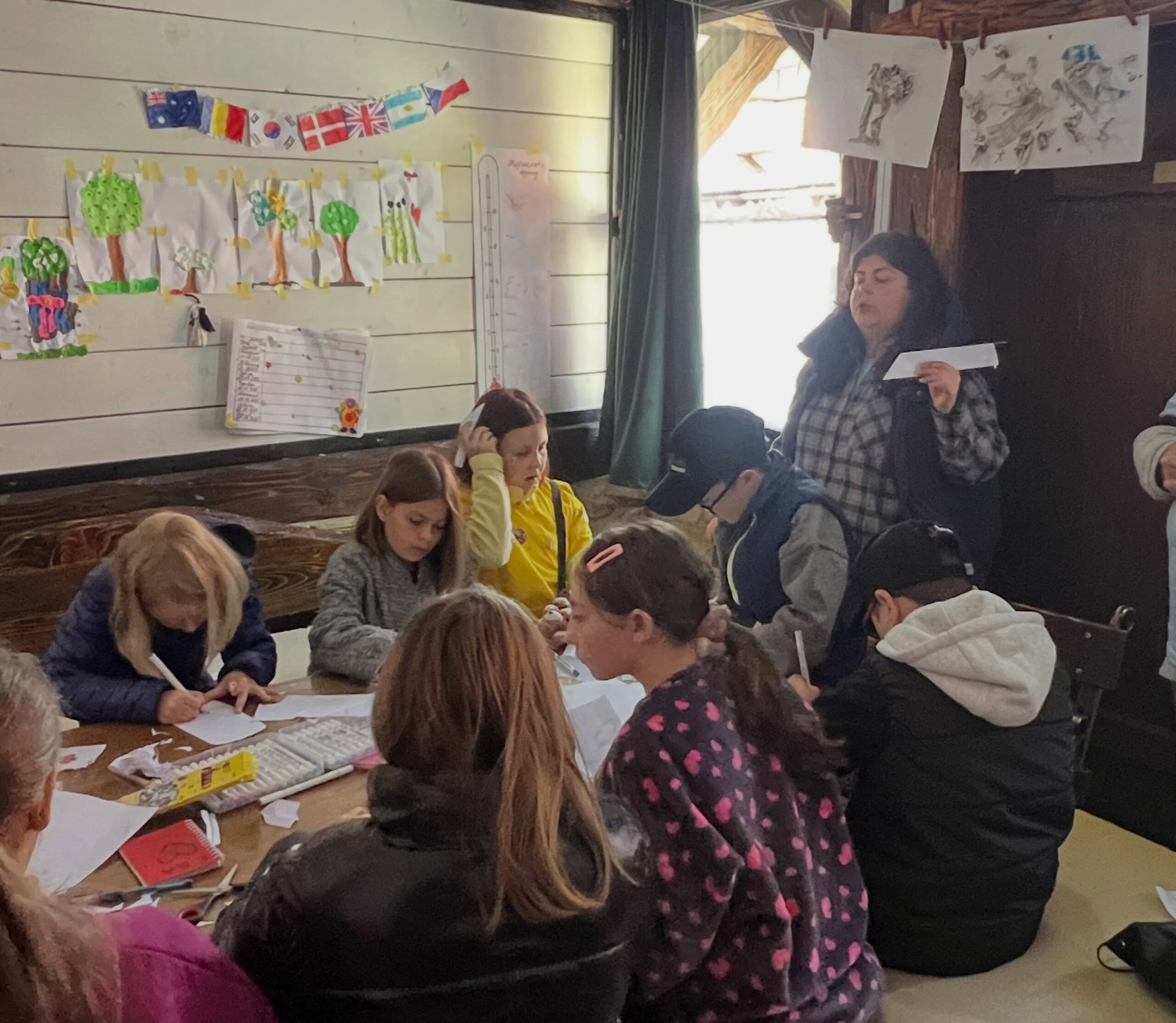
TRT session run by Iryna’s charity in Volovets, Ukraine, for families of fallen soldiers, September 2026.
How Ukrainian children have been helped by TRT since 2014 is assessed in an article in the journal Social Work & Society. Written by Kyiv-based psychologist Iryna Sukhova, it describes the reach of a TRT programme run by local charity HOPE worldwide Ukraine and its partners in-country, which has reached over 15,000 children and 4,000 parents in that time.
“Since 2014, the programme has been applied in Ukraine and bears the official approval stamp of the Ministry of Education of Ukraine,” Iryna writes. “The widespread implementation of the programme has helped thousands of children and their parents. As of 2025, the programme continues to be one of the key instruments of psychosocial assistance for children and their parents who have experienced the traumatic impact of war. The work continues in all regions of Ukraine and far beyond the country’s borders.”
Describing the effect of this conflict on Ukrainian children, she notes: “The experience of war has a multidimensional impact on the psyche of children, manifesting in post-traumatic disorders, fears, problems with social functioning, and the risk of mental illness in the future. The loss of basic needs, trauma, and a sense of danger form destructive emotional and behavioural reactions that require timely psychological support and a stable environment.
“An effective aid instrument is the Children and War Teaching Recovery Techniques programme, based on a cognitive-behavioural approach and adapted to Ukrainian realities. It combines a group format, structured sessions, and consideration of children’s individual characteristics, contributing to a reduction in post-traumatic stress symptoms, the restoration of a sense of safety, and the formation of self-help skills.”
How this has been applied has varied since the war began in 2014, Iryna explains. “During the period 2014-2021, it was applied predominantly to children who had already left the combat zone, and the traumatic event was of a concluded nature. In contrast, since 2022, the focus has shifted towards assisting children in a situation of ongoing danger. This necessitated the adaptation of the programme, namely accounting for high levels of anxiety, organising sessions in safe locations, and preparing for emergency situations.”
The programme has delivered TRT to children in groups of 10-15, typically aged from 7-8 years. Teenagers and adults have also participated, in separate groups, including specially adapted sessions for the elderly.
Her study indicates that the results have been highly beneficial. “The positive impact on the psycho-emotional state of participants after completing the sessions should be emphasised. Upon completion of all sessions, a significant reduction in symptoms of depression and anxiety is observed, alongside improvements in sleep and social adaptation. Children note that they feel capable of managing their own emotions, body, and memories, cope with difficult stressful situations much more easily, understand the origins of their distressing experiences, and their sense of fear diminishes or disappears entirely.
“Upon completing the work, participants realise that they are not alone and that there are people capable of understanding them. According to the results of psychodiagnostic assessments of children, a decrease in indicators on the Intrusion, Hyperarousal, and Avoidance scales – symptoms of post-traumatic stress – is observed.
“Even in a situation of ongoing war, children are capable of recovery provided they receive targeted support. In the Ukrainian case, the restoration of trust in one’s surroundings and a sense of safety are crucial for the stabilisation of emotional state. The results of this work underscored the significance of working with children in groups, which allows for the normalisation of experiences through shared experience.”
But the work is not yet over, she argues. “It is noteworthy that demand for training in the programme methodology persists to this day. Not only psychologists but also teachers, social workers, medical professionals, and specialists from other fields involving social interaction seek to receive training and work with children and adults.”
Iryna’s full article, ‘The Ukrainian Experience of Implementing the “Children and War. Teaching Recovery Techniques” Programme During the Russo-Ukrainian War’, can be read here. Her organisation, HOPE worldwide Ukraine, can be contacted here.
“Even in a situation of ongoing war, children are capable of recovery provided they receive targeted support.”

